Every real-time app I've built eventually hit the same fork in the road.
Managed platforms like Convex and Firebase are lovely to build on. Then you notice your data lives on their servers and the bill climbs with your traffic. The other option is raw Cloudflare, Workers and Durable Objects, where you own everything and pay edge prices, but you spend your weekends hand-wiring RPC, types, and subscriptions. Good bones, no developer experience.
Lunora is what I wanted instead: that managed-platform DX, running on the Cloudflare account I already pay for. You write a schema and some TypeScript functions, and Lunora turns them into Workers backed by Durable Objects, with end-to-end types and reactive hooks (React, Vue, Svelte, Solid) that update live over WebSockets. It's open source.
Fair warning: it's alpha. The APIs will move under you and I wouldn't ship it to production yet. But you can build something real with it today. Here's what that looks like, and where it falls short.
One file to start
Define your tables once. You get a fully typed data model, no ORM and no migration tool to learn.
// lunora/schema.ts
import { defineSchema, defineTable, v } from "lunorash/server";

export default defineSchema({
    messages: defineTable({
        author: v.string(),
        body: v.string(),
        ts: v.number(),
    }).index("by_ts", ["ts"]),
});
Functions, not endpoints
Queries and mutations are typed builders. Inputs get validated, return types are inferred, and you never write a DTO.
// lunora/messages.ts
import { query, mutation, v } from "./_generated/server";

export const list = query.query(async ({ ctx }) => ctx.db.query("messages").order("desc").take(50));

export const send = mutation.input({ author: v.string(), body: v.string() }).mutation(async ({ ctx, args }) => {
    await ctx.db.insert("messages", { ...args, ts: Date.now() });
});
The client stays live
Import the generated api and your components subscribe over WebSocket. Nothing to wire up, no cache
to invalidate. Someone sends a message, every open client updates.
import { useQuery, useMutation } from "@lunora/react";
import { api } from "../lunora/_generated/api";

function Chat() {
    const messages = useQuery(api.messages.list) ?? [];
    const { mutate: send } = useMutation(api.messages.send);
    // `messages` is fully typed and stays live. Optimistic writes and an
    // offline queue come for free.
}
Rename a field, break the build
Schema, validators, query results, and hooks all share one source of truth. Change a field name and your component stops compiling. In your editor, not in production at 2am.
Own it, or let us run it
This is the part most real-time backends skip. The same code runs two ways, and you're never stuck with one:
- Self-host on your own Cloudflare account. Free, open source, your data, roughly $0 at idle on the free tier.
- Lunora Cloud (soon). The same code, managed for you, for teams that would rather ship than babysit infrastructure.
You can always grab the open source and self-host. That's the whole point.
Scale when you actually need to
Start with one Durable Object. It's the simplest thing to reason about. When you outgrow it, opt in per function, no rewrite:
cursors: defineTable({
    roomId: v.string(),
    x: v.number(),
    y: v.number(),
})
    .shardBy("roomId") // one Durable Object per room or tenant
    .index("by_room", ["roomId"]),

// …or, for a read-mostly table nobody shards:
regions: defineTable({ code: v.string(), name: v.string() })
    .global(), // geo-replicated reads at the edge
Same code, different topology. The two are alternatives — a table picks one tier, and declaring both throws.
Where it's rough
Lunora has fewer built-in features than Convex right now, and it's alpha, so expect breaking changes before the first stable tag. If you need production-ready today, pick something mature. I'd rather say it here than have you find out the hard way.
Try it
One command gives you a typed, live-syncing app:
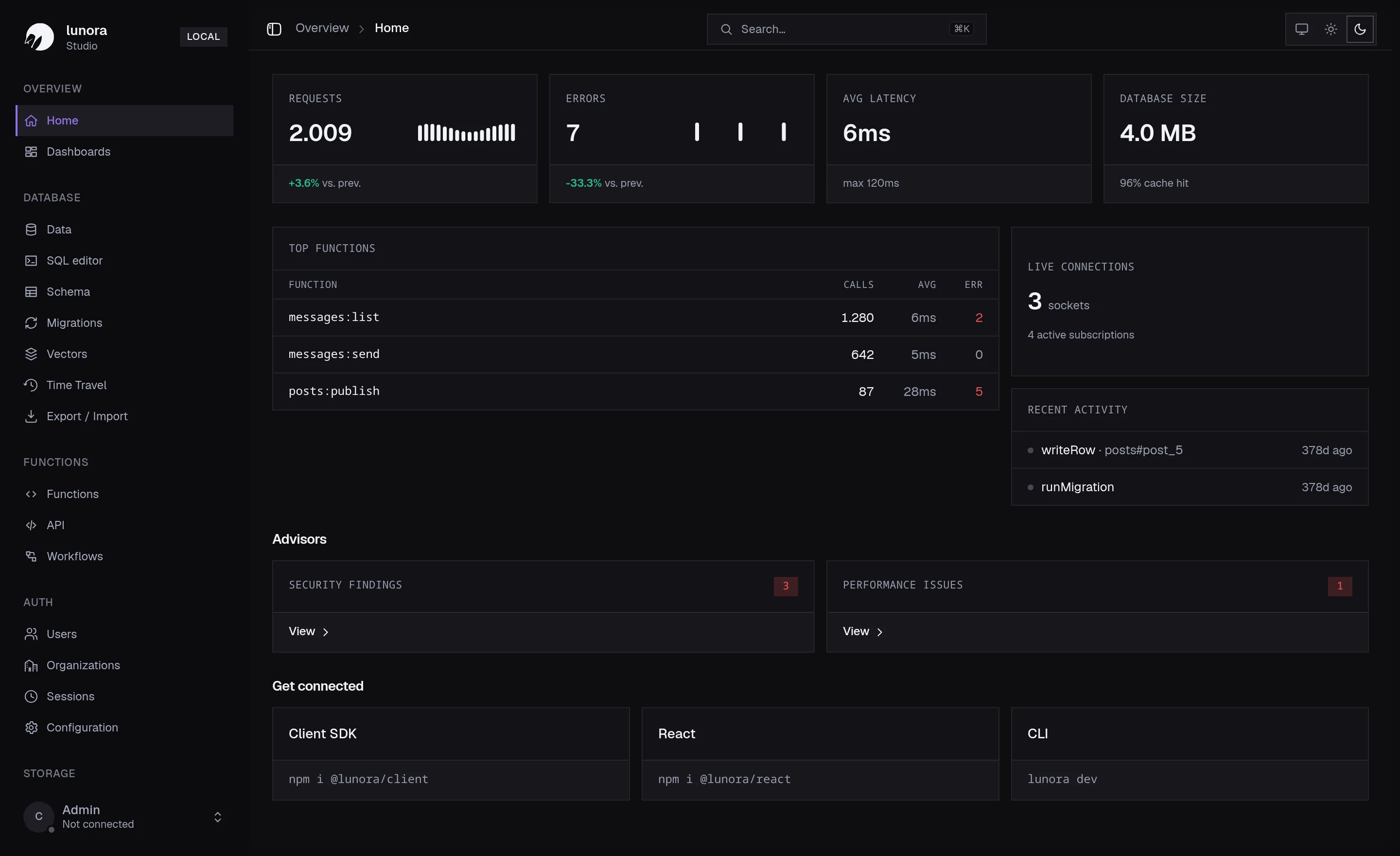
pnpm dlx lunorash@alpha init my-apppnpm dev boots workerd (the real production runtime), generates your types, starts Vite, and reloads
on save, with a local Studio for your schema, data, and logs.
It's alpha and open source. Build something with it and tell me where it breaks. That's how I'm deciding what to work on next.
- Star the repo
- Read the docs
- See how it compares to Convex, Supabase, Firebase, and Appwrite
- Join the Lunora Cloud waitlist